
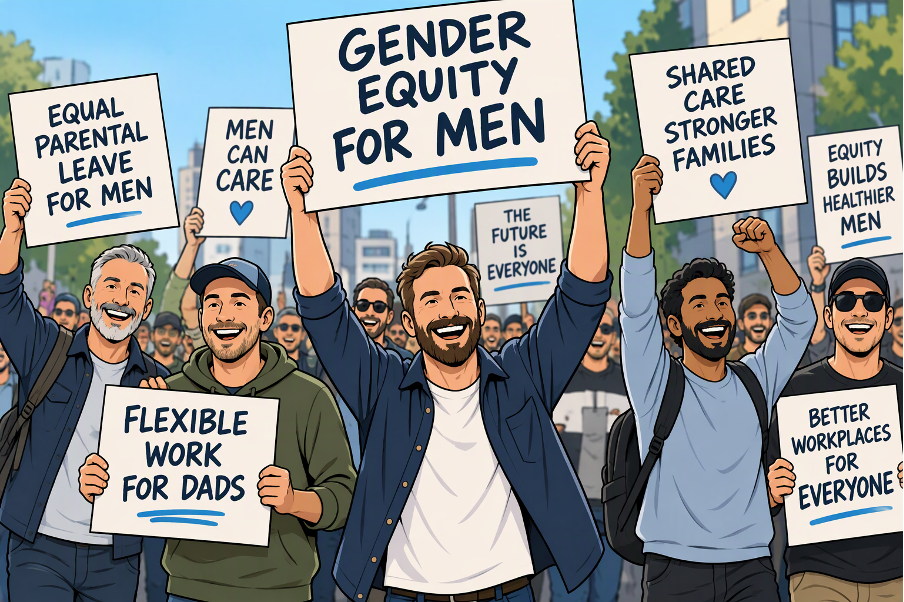
Illustration generated with AI and edited by TOPP team.
International Men's Day is often framed as a day to celebrate the contributions of men and boys and to consider the challenges they face. Less widely recognised is that one of the founding objectives of International Men's Day is to improve gender relations and promote gender equity. This year's theme, "The Future Is Everyone", provides an opportunity to bring that objective back into focus.
At first glance, gender equity and International Men's Day might appear to sit in separate conversations. In reality, they are deeply connected. Gender equity is not simply about advancing opportunities for women. It is about creating workplaces, communities and institutions that enable everyone to participate, contribute and thrive. When we remove barriers based on gender, everybody benefits. This makes gender equity not just relevant to International Men's Day, but central to its purpose.
Gender equity is good for men
Discussions about gender equity often focus on the barriers women continue to face in leadership, economic participation and decision-making. Those issues remain critically important. However, gender inequity also negatively impacts men.
Traditional expectations can still position men as primary breadwinners, place pressure on them to prioritise work over family, and discourage help-seeking, vulnerability and caregiving. These expectations can limit men's choices just as gender stereotypes limit opportunities for women.
A growing body of research suggests that more gender-equal societies are associated with better health, wellbeing and relationship outcomes for men as well as women. Flexible workplace cultures, equitable caregiving arrangements and inclusive leadership models create benefits across the community.
Research by The 100% Project has also highlighted that men are not a homogeneous group. Different men engage differently with gender equity initiatives, but many support workplaces where flexibility, respect and shared responsibility are normalised. Creating more inclusive cultures is not about excluding men. It is about helping more people succeed.
From Gender Equity Victoria's perspective, gender equity is also fundamental to preventing gendered violence. Evidence from Australia and internationally demonstrates that rigid gender stereotypes, unequal power structures and discrimination create conditions that increase the risk of violence against women. Promoting equity and respect helps create safer communities and healthier relationships for everyone.
The message is simple: gender equity is not a women's issue. It is a social and economic issue that benefits men, women and gender-diverse people alike.
Leadership needs a redesign
One of the clearest examples of where gender inequity persists is leadership.
Despite decades of effort, leadership structures continue to be built around assumptions that reward constant availability, long working hours and traditional career pathways. These assumptions no longer reflect the realities of modern work and family life.
According to the Workplace Gender Equity Agency (WGEA), women continue to leave management roles at higher rates than men, contributing to what researchers describe as a persistent "missing middle" in Australia's leadership pipeline. A significant factor is the limited availability of flexibility in senior roles.
WGEA's research also identifies a "part-time promotion cliff". While around one in five Australian employees works part-time, only a small proportion of managers, senior executives and CEOs do so. Flexibility often becomes less available precisely when people move into leadership roles. This should concern all of us.
When leadership is designed around a full-time, always-on model, many talented women face barriers to advancement. At the same time, men who want to take on greater caring responsibilities may feel unable to access flexible work without damaging their careers. The solution is not simply to encourage more women to fit existing leadership structures. It is to redesign leadership itself.
Part-time leadership roles, job-share arrangements, flexible executive positions and outcome-focused ways of working have the potential to expand access to leadership for a broader range of people. Organisations that embrace these approaches are better positioned to attract and retain talent while responding to changing workforce expectations. If we genuinely believe that the future is everyone, leadership must become accessible to everyone.
A more equal future benefits everyone
The theme of International Men's Day this year invites us to imagine a future that works for all people, not just some. This future includes workplaces where flexibility does not disappear at senior levels. It includes leadership pathways that recognise different life stages and caring responsibilities. It includes cultures where men can take parental leave without stigma and where women can pursue leadership without structural barriers.
For employers, this means redesigning systems, policies and leadership roles to support genuine flexibility and equal opportunity. For leaders, it means challenging assumptions about who leads, how leadership is demonstrated and what success looks like.
For governments, businesses and community organisations, it means continuing to invest in evidence-based gender equity initiatives that improve participation, representation, safety and wellbeing. Victoria's gender equity reforms, for example, have demonstrated the value of measuring progress and holding institutions accountable for outcomes. Most importantly, it means moving beyond the idea that gender equity is a competition between men and women.
The future envisioned by International Men's Day is one where boys can grow into caring fathers and leaders. One where girls can pursue leadership without barriers. One where flexibility is available regardless of gender. One where respect, opportunity and inclusion are shared by everyone. International Men's Day should not be a conversation about who is winning. It should be a conversation about how we build workplaces, families and communities where everyone can contribute and everyone can thrive.
What should we do next?
This International Men's Day provides an opportunity to move the conversation beyond division and towards action and progress.
We should:
Design leadership roles to be genuinely flexible, including part-time and job-share opportunities.
Encourage and normalise men's uptake of parental leave and flexible work.
Challenge outdated assumptions about masculinity, leadership and care.
Measure and report on leadership representation, flexibility and career progression.
Recognise that gender equity strengthens organisations, families, communities and economies.
These priorities align closely with the work of both The 100% Project and Gender Equity Victoria by tackling structural barriers, promoting inclusive leadership and creating workplaces where opportunity is not constrained by gender. We aim to lead the way by collaborating and working together to support and amplify work of all the efforts out there to create a more gender equitable Australia. Gender equity is not a distraction from the purpose of International Men's Day. It is one of the most important ways we can achieve it.
The future is everyone.
Co-authors

Mark Morris (he/him)
Co-Chair, The 100% Project
Mark is a passionate advocate for positive masculinity and gender equality. He is an active dad, and volunteers at his children’s school and local football club.
With more than 20 years of leadership and management experience in both public and private sectors, he specialises in People & Culture, and is an accredited executive leadership coach.
Micaela Drieberg (she/her)
Chief Executive Officer, Gender Equity Victoria (GEN VIC)
Micaela, a committed feminist, is a strategic, collaborative leader with over 20 years of experience across for-purpose sectors, including all three levels of government, universities, not-for-profit organisations and peak bodies. Micaela has previously served as a Mayor and Ministerial Adviser.
In addition to her work with GEN VIC she is also a Teaching Associate with Monash University and participates in several government advisory bodies.
References
Bankwest Curtin Economics Centre & Workplace Gender Equality Agency. (2026). Gender Equity Insights: Breaking Through the Glass Ceiling and the Glass Walls.
Gender Equity Victoria. (2024). Gender Equity and the Prevention of Gendered Violence Resources.
International Men's Day. (2026). The Future Is Everyone and International Men's Day Objectives.
The 100% Project. (2024-2026). Research on Men, Gender Equity and Inclusive Leadership.
Workplace Gender Equality Agency. (2023). Part-time Managers: Improving Workplace Flexibility and Gender Equity.
Workplace Gender Equality Agency. (2023). Australian Workers Face a Part-time Promotion Cliff.
Commission for Gender Equity in the Public Sector. (2026). State of Gender Equity in Victoria.